
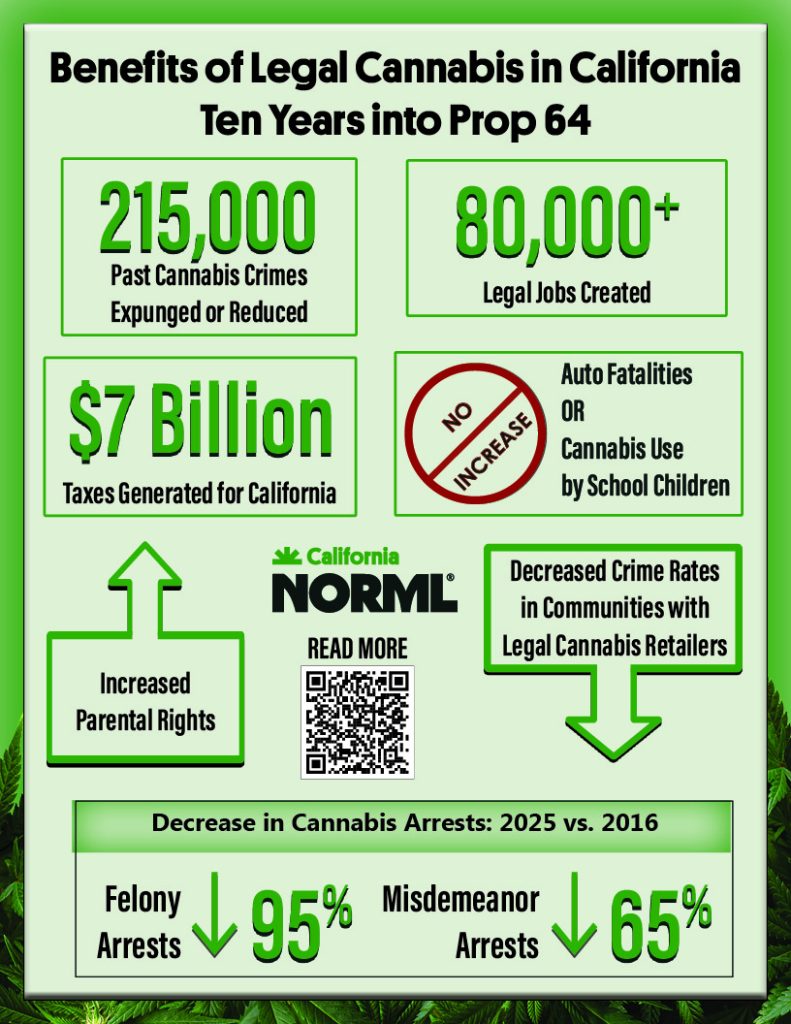
Since Californians legalized adult cannabis use and sales 10 years ago in 2016, our state and its citizens have seen many benefits from the laws that Prop. 64 put in place.
CRIMINAL JUSTICE AND HUMAN RIGHTS BENEFITS
- Prop. 64 has lead to reduced cannabis arrests and imprisonments. The CA DOJ reported 7,949 felony and 5,861 misdemeanor arrests in 2016 vs. 399 felony and 2,033 misdemeanors in 2025. Unfortunately, racial disparities in arrests remain.
- Over 215,000 past cannabis crimes have been expunged or reduced from people’s records, opening up job and other opportunities for Californians.
- Parents who are medical marijuana patients have their child custody rights protected under Prop 64.
ECONOMIC BENEFITS
- The California cannabis industry has created 80,000+ legal jobs in what was previously a criminal enterprise (Source.) Many of these are union jobs, and equity businesses are supported in many jurisdictions.
- Cannabis brings in over $4 billion in legal sales yearly.
- Cannabis sales generate $1 billion/year in tax revenues ($600M in state excise taxes and $400M in sales taxes) that fund programs across the state supporting law enforcement, environmental clean up, and youth substance abuse prevention. Since 2018, California has collected more than $7 billion in cannabis tax revenue supporting research, enforcement, environmental clean-up and community programs.
- Local jurisdictions that allow legal cannabis businesses across California have also benefited from sales and payroll taxes, funding local programs.
- Cannabis events and tourism are bringing people to cannabis-producing regions of California, boosting spending on hotels and restaurants. Cannabis lounges and cafes are opening across the state, re-building community and educating consumers.
HEALTH BENEFITS
- California cannabis consumers can now enjoy products that are tested for contaminants and labeled for potency, purchased in safe environments.
- Medical marijuana offers safe legal alternatives to opioids and other prescription drugs in the treatment of chronic pain and other medical conditions.
- There has been no increase in cannabis use by school children post legalization. A Kaiser study found increased teen use in early years post-64, but the trend reversed with COVID, and adolescent use is down to 6.5% in 2024, slightly below 2016 rate of 6.8%. According to CDPH, CA youth had significantly lower cannabis use than the national average for 8th, 10th, and 12th graders as of of 2019. There has also been “No Significant Uptick in CA Adult Use After Legalization” (CA Health Interview Survey 2018-23).
- Studies have shown decreased binge drinking by young adults. “Binge drinking down among young adults 18-25: LA County.” There is no clear trend in overall alcohol consumption following legalization – beer and wine consumption are down, but hard liquor is up.
- There has been an increased reported incidence of emergency room visits, cannabis use disorder and psychotic reactions, especially among young users, but Prop 64 is funding ongoing research and evaluation of cannabis and legalization. Cal NORML advocates for better education and labeling of cannabis products to reverse these trends, which may be bolstered by increased self-reporting and evaluation. We also advocate for increased research on vaporization and other safety measures.
PUBLIC SAFETY BENEFITS
- Crime rates have dropped in communities with legal cannabis retailers.
- Licensed retailers don’t sell to minors, and Prop. 64 banned advertising directed at children and required child-proof packaging.
- Contrary to the prediction of critics, there has been no surge in auto fatalities since cannabis legalization. DUI arrests are down 21% from 2016 to 2024 (from 131,157 to 104,057). California has followed a general national trend, which was toward lower overall auto fatalities, until jumping up during the pandemic. As of latest data in 2024, California had a lower rate of auto fatalities than the national average (9.8 deaths/100,000 CA vs 11.5 for US).
ENVIRONMENTAL BENEFITS
-
Licensed cannabis businesses must meet CEQA requirements, including strong environmental protections for noise, air quality, cultural resources, protected species, energy use, hydrology and water quality etc.
-
Cannabis farms must have biological reports prepared by licensed professionals before licensure, to ensure protection of species and habitat. Cannabis cultivation is overseen by CDFW, CalFire, State Water Resources Control Board etc. – making it one of the most highly regulated forms of agriculture. Due to strict testing requirements, legal cannabis is often grown without harsh pesticides.