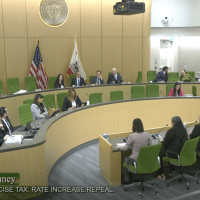
UPDATE: City councilmembers heard from several patients, activists and West Sacramento residents in support of cannabis equity at their meeting on 1/21/2026.
The City of West Sacramento is choosing to scrap its cannabis equity program rather than grant a license to an equity applicant it approved last year.
Applicant Richard Miller not only meets all of California and West Sacramento’s stated social equity eligibility criteria, he and his business STASH successfully advanced in the RFP process to open an equity business, receiving a letter on July 17, 2025 so stating. However, in late September 2025, the City notified Miller that it was canceling the entire Equity Retail RFP, offering no rationale for the move, as required by law. City officials had until had until January 9, 2026 to respond to a demand from Miller’s attorney Khurshid Khoja; no response was provided.
EQUITY AND THE APPLICANT
Cities across California (and in other regulated US state markets where cannabis commerce is lawful) have adopted social equity cannabis licensing programs, professing an intent to redress the harms of the War on Drugs. Specifically, social equity was intended to redress the myriad injuries endured by individuals who were previously arrested and/or convicted of non-violent offenses that would today constitute lawful cannabis commerce.
According to the CA Dept of Cannabis Control’s website, “California’s cannabis equity efforts support people and communities harmed by cannabis criminalization. These efforts lower barriers to the cannabis industry for those hit hardest by the War on Drugs.” This includes, “people convicted of a cannabis offense. In 1988 Miller was targeted in a sting operation in Foster City by someone posing as a medical marijuana patient and convicted of a cannabis offense. Subsequent arrests in Rancho Cordova and Auburn have affected his employment opportunities, his health, and his driving and child custody rights.
Born in San Francisco, Miller owned printing businesses in the Bay Area. He became active in the medical marijuana movement when his uncle was diagnosed with AIDS, and donated supplies and printing services to San Francisco’s Prop. P campaign to legalize medical marijuana in 1991 and the subsequent statewide Prop. 215 campaign in 1996. Meanwhile, he baked cannabis cookies to donate to AIDS patients at Golden Gate Charities and the Bartlett House where his uncle was house, and assisted patients in wheelchairs at protests.
Miller, who identifies as gay, still proudly holds one of the original pre-Prop 215 caregiver cards issued by legendary medical cannabis patient advocate and AIDS activist Dennis Peron. In 2005 he moved to Sacramento and has worked to implement reforms at the state level, working with several advocacy organizations like California NORML and Americans for Safe Access. In 2022, Richard was named “Patient Advocate of the Year” by ASA.
WEST SAC’S GRANT TO DEVELOP CANNABIS RETAIL & EQUITY BUSINESSES
The DCC’s Cannabis Local Jurisdiction Retail Access Grant Program provided funding to local governments to support the development and implementation of a local cannabis retailer licensing program in 2023. DCC’s grant guidelines state: “An eligible jurisdiction may receive funding up to the maximum amounts listed in Table A, based on the local jurisdiction’s population…Additional funding will be awarded to local jurisdictions that include a proposal to issue retail licenses to qualified local equity businesses.”
At West Sac’s population level, they were eligible for a grant of $175K, plus an additional $60K if they were implementing an equity program. They were awarded a total of $235K, since their grant application had an equity component. The City is missing out on millions more in grants from the Governor’s GoBiz office that other cities and counties with equity programs are being awarded. In addition, two-year grant funding of $250K each year to support cannabis equity businesses was reportedly earmarked as part of the Entertainment District Public Safety and Security project to be funded by West Sacramento’s Measure N, which passed on November 6, 2018. Those funds have yet to be disbursed.
West Sac’s website states that planning commission staff is “developing a retail (storefront and non-storefront) program with a social equity component for further consideration by the City Council.” But now the council plans to scrap the program for which they accepted a state grant to develop.
WHAT’S NEXT?
“If anyone deserves a license to serve California’s medical marijuana patients, it’s Richard Miller,” said Ellen Komp, Deputy Director of California NORML. “West Sacramento would enjoy tax revenue, employment opportunities, and other benefits to the City if it does the right thing and reverses its decision to rescind Richard’s RFP award.” The City now plans to open up their General Retail Cannabis Program, for which anyone can apply. “Unfortunately, we’ve seen small and equity businesses squeezed out of these processes, where licenses largely go to out-of-town chain stores that often don’t include local or equity brands among their offerings, and don’t prioritize patient needs,” Komp added.
West Sacramento residents are encouraged to contact their councilmember in support of the city’s equity program, and plan to attend the city council meeting on Wednesday, January 21 to make a public comment.