
UPDATE 1/26/2026: Asm. Irwin’s bill to ban disposable vapes passed in the Assembly Appropriations committee and was headed for a floor vote when it was amended to remove cannabis vapes from the language.
Cal NORML favors shifting to vapes with removable batteries and developing disposal options for cannabis vape waste.
Manufacturers and retailers should explore re-designing vapes with removable batteries, and/or provide waste disposal programs for cannabis cartridges, vape pens, and batteries.
See: THE GREEN PUFF: TRANSFORMING CANNABIS VAPING INTO A SUSTAINABLE PRACTICE and
Consumers should be aware of proper disposal options for cannabis cartridges and integrated cannabis vaporizers.
Consumers: Check with your licensed cannabis retailer to see if they have a waste disposal program.
You can use this link to find an authorized hazardous waste facility near you.
Find Waste Management Locations.
Also see: How to Dispose of Vape Pen Batteries.
The Montana Department of Environmental Quality guide on cannabis waste disposal, including vape waste (page 17).
If All Else Fails…
If you live hundreds of miles away from any of these drop-off points and don’t want a pile of batteries building up (as they may catch fire), you will need to process the batteries yourself:
- Discharge each battery completely and allow them to cool.
- Submerge them in cold salt water for a full two weeks, covered with a secure lid.
- Wrap them in a newspaper and put them in the trash.
The aim of this process is to make the electrolyte fluid safe so that the batteries won’t explode or ignite. Remember that ignition is the main risk of improper disposal.
Treat your lithium-ion e-cigarette batteries just as you would your vape pen batteries. And if you have plastic e-liquid bottles (or liquid nicotine bottles) and cartridges for your e-cig, you can recycle those normally. Just make sure to first rinse any remaining residue from bottles.
Also see: Vaping Resources and Products
Cal NORML Launches Vape Safety Study
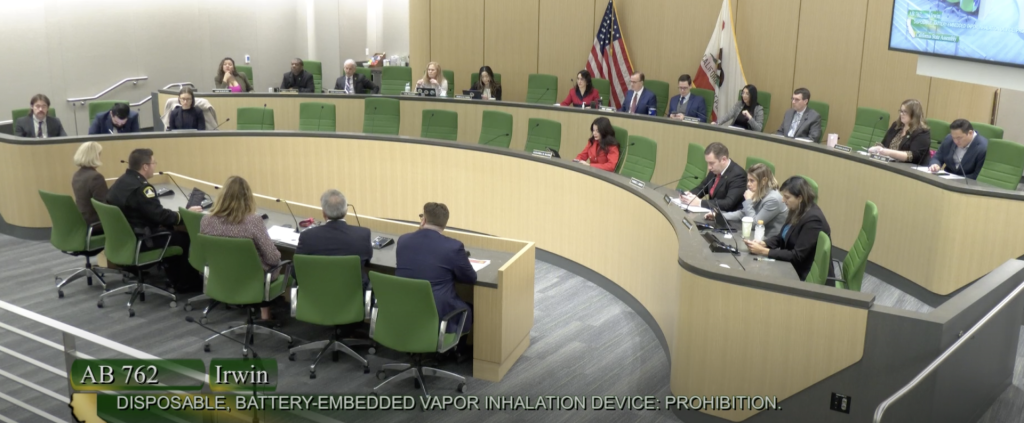
Read our report below on the bill’s first hearing this year, along with feedback on the bill from Cal NORML members and supporters.
Asm. Jacqui Irwin (D-Thousand Oaks) brought her bill AB 762, to ban disposable nicotine and cannabis vape pens, to the Assembly Business and Professions Committee for a hearing on Tuesday, January 13. Disposable devices are incredibly popular, you can see them everywhere, including in childrens’ backpacks, Irwin said. Most look like pens, but screens and buttons are being added to play video games like PacMan or Tetrus. Disposable vape pens designs intend them to be thrown away, rather than refilled or recharged. Lithium ion batteries are flammable, igniting garbage trucks and recycling centers.
She pointed to the UK, which has banned disposables, and reported that 85% of customers there switched to reusable products. She said she had to omit vape products from her battery recycling bill because “we couldn’t find a way to recycle them.” We’ve been on a mission, she said, with AB 2440 just coming online and SB 1215, one on loose batteries, one embedded. This category got carved out of the embedded law that just came online January 1. She passed around samples of reusable vs. disposable vapes. (Jokes were made about about how they were just to look at, not use.)
Irwin brought up witness Joe La Mariana of ReThink Waste and a Doug Subers from CA Professional Firefighters to talk about problems with fires at recycling centers due to lithium ion batteries. LeMariana said there have already been two fires at facilities this year; they are quite common.
Those standing to add their support included the League of CA Cities, CSAC, RCRC, the cities of Alameda and Thousand Oaks, Santa Clara and Santa Barbara counties, LA County Sanitation Districts, and the San Francisco Board of Supervisors. Also, the Product Stewardship Council – Stop Waste, Nor Cal Recycling Association, Parents Against Vaping, and the Teamsters, among others.
THE OPPOSITION SPEAKS
Amy Jenkins of CaCOA provided opposition testimony on behalf of the cannabis industry. Lithium ion batteries are ubiquitous, she said, and this bill doesn’t address improper disposal or educate consumers about it. Disposables serve unique medical patients and accessibility, since dexterity issues preclude changing batteries for some. Consumers do shift to readily available illegal products, e.g. harmful EVALI products.
Sacramento County Sheriff’s deputy Nate Grgich spoke about the illicit market, which he said is increasingly tied to organized criminal networks, many coming from overseas, calling it a health risk and national security concern. He said there were 150 operations into smoke shops last year in Sacramento County raiding businesses with products marketed to minors.
Opposition support came from CCIA, the CA Roundable Business Assn., CA Grocers and Retailers Associations, and the Hispanic and Asian Pacific Chambers of Commerce, along with Weedmaps, the Cannabis Distribution Association, Marsh & Ash and the Catalyst Cannabis Co.
THE COMMITTEE ASKS QUESTIONS
Asm. Philip Chen (R-Orange, San Bernardino) said that 90% of unregulated market comes from from China and asked how does the bill would address that. “We find it hard to believe this bill will impact illicit market,” Irwin said, pointing to two “very strong” enforcement mechanisms in bill: license revocation and civil penalties.
Chen then asked the opposition, “Does this have teeth or is this a drop in the bucket?” Jenkins responded that the lion’s share of enforcement dollars have gone to illicit grows; there has been a lack of emphasis on retail. She noted there is an illicit dispensary on K St. near the capitol, where you can buy an integrated vaporizer, and will continue to be able to buy if this bill passes.
Asm. Heather Hadwick (R-Alpine, Amador, El Dorado, Lassen, Modoc, Nevada, Placer, Plumas, Shasta, Sierra, Siskiyou counties) asked if CA’s ban on flavored vapes increased the illicit market? Irwin pointed out this would make enforcement easier, since law enforcement won’t have to distinguish between flavored and nonflavored vapes. (She added: I’d like to see the K St. store closed too.) The Sheriff’s deputy agreed that it is hard to distinguish flavored vapes from others. Fine is $500. Jenkins added that flavored vapes are rampant, despite very robust penalties already in MACURSA, can be $30K per violation.
Hadwick said she spent 12 years on her county’s tobacco coalition. There is no punishment possible for kids at school, and 90% of products are from China and not FDA controlled. “I just don’t think this bill is the answer. The 10% of those who are legal aren’t the problem,” she said. “My average age of kids caught was 10 years old. This is ruining our youth.”
Asm. Sade Elhawary (D-Los Angeles) drilled down, asking: Based on some of the illicit market packaging coming from China, what would be effective?
Jenkins replied that previous legislation did require packaging and labeling, and consumer information about proper disposal. If you eliminate a portion of our retail vaping sales, you’re eroding some of that education material that is provided. Integrated vaporizes represent 40% of sales. There are responsible suppliers who do have take-back programs e.g. Marsh & Ash. This bill would take some of that away.
[AB 1894, which took effect in July 2024, requires labeling and mandatory consumer education about proper disposal at hazardous waste facilities on disposable. Licensed manufacturers are complying, and the regulated market has the infrastructure and accountability to address environmental concerns responsibly, CaCOA says, adding that AB 762 dismantles that progress.]
Elhawary noted the llicit market is huge, and oftentimes the fires are coming from that market. She said, I don’t want to be harmful to an industry that’s struggling; although I support bill.
Newcomer Asm. Natasha Johnson (R-Riverside) opined that she can’t imagine a consumer who’s buying an illicit product will be concerned with waste management. Don’t understand how banning a legal product will help. Irwin replied that this is an incremental change that will have negligable impact on consumers. She pointed again to UK and enforcement piece. Johnson replied, I don’t know how we can regulate what we can’t ban. If we’re removing the cleanest version of what we have right now, we’re left with the dirtiest version.
Johnson asked what has happened in good faith negotiations with opposition since the bill was introduced last year. Irwin replied that there was concern from business owners about stock on hand, which was addressed with the addition of a sell-through date of January 1, 2028. The AG’s office or city and county attorneys would be responsible for enforcing the bill.
Asm. Maggy Krell (D-Sacramento) also expressed concerns about the illicit market; does this bill exacerbate that? Asm. Bauer-Kahan thanked Sac sheriff for his work in district. She said she will be supporting; she represents a very large senior community that relies on cannabis for things like arthritis. I want them to have access to the legal market. There’s a difference between how long tobacco vapes last vs. cannabis (others said cannabis vapes could last 6 months). I support related to tobacco piece. I’m hopeful that we can move in that direction going forward.
Dr. Jasmeet Bains (D-Kern Co.) said she will be supporting. We have two fundamental things: illicit vs. licit. But inaction is not a good thing either. Implementation is a factor; where is the implementation of many laws we pass? Also, I don’t our kids to be caught in this debate.
Asm. Alexandra Macedo (R-Fresno) asked about border states selling disposables, relating it to flavored tobacco, saying, “I know people that load up on flavored tobacco when they go to border states. We’re missing that tax income.” I share environmental concerns but I think there are other work arounds, she said.
Chair Marc Berman (D-San Mateo, Santa Clara) closed the hearing by saying, this is a very thoughtful, detailed conversation. This is not a silver bullet. It won’t solve the problems of the illicit market or youth use. But it’s an incremental step in the right direction. People can drive to Reno for a disposable but that seems like a lot of work when could get a reusable one here. There needs to be more enforcement, towards stores instead of grows. But this addresses concerns about environment and waste facilities (he added that he appreciated a tour he got of one facility). Risk and insurance costs have gone up and that gets passed on to all consumers. I know you’ll continue to have conversations with opposition on “tweaks” to bill.
The measure then passed by a vote of 10-5, with Democrats Ahrens, Bains, Bauer-Kahan, Berman, Caloza, Elhawary, Haney, Irwin, Lowenthal and Pellerin voting in favor. Voting no were Republicans Alanis, Chen, Hadwick, Johnson and Macedo. Not voting were Democrats Jackson, Krell and Nguyen. The bill now heads to the Assembly Appropriations committee on January 22. The next stop would be the Assembly floor, and then Senate committees.
FEEDBACK FROM CAL NORML MEMBERS:
Cal NORML put out a call last week for feedback on the bill from our members and supporters. Here are some of the responses:
– What we truly need is a legal exemption for retailers to be allowed to collect these batteries and empty cartridges in a collection can that can be deemed as household hazardous waste for free disposal at the waste center, and not charge the businesses that sell vaporizer products to dispose of the waste stream that their customers are generating.
– I like the idea of adding a small “ecomodulation fee.” An option to avoid that is to adopt a technology with a removable battery.
– The last thing the legal market needs is another rule pushing folks to the street, esp. re: a popular modality. Stoners love the Earth and don’t want to pollute landfills with batteries. They just need a place to send them.
– If disposable vapes means the whole unit can be thrown away, and can’t be recycled, I don’t use them. I think the disposables are bad for the environment (so are vapes in general). Still, I hate to see the bureaucrats banning them.
– This environmental catastrophe should never have been permitted in the first place; these worthless pieces of trash cannot be banned fast enough. Cannabis should NEVER be a pathway for environmental destruction.
– I use them but very reluctantly. I’ve got about 50 of them at home; disposal is a problem. If asked to vote, I would probably abstain.
– In a pinch, or when traveling, I might get one for the moment.
– I use disposable thc/cbd vape cartridges. The products I object to are the ones with excessive packaging (a great percentage), and the all-in-one vapes where the battery gets tossed too. I have had the same battery devices for years and although I am distressed at the amount of waste involved with the 510 and other styles of cartridge systems, I at least am not putting batteries in the waste system. My husband uses nicotine vapes and although some of them have a reusable battery, most are all-in-one “disposables”. We save the devices when they are empty and take them to the local hazardous waste depot en masse. I would like to see a refillable thc vape system, but so far that seems unreachable.
– State-licensed cannabis vapor products should be removed from the scope of this bill, due to the current fragility of the cannabis market, and for practical reasons. Including regulated cannabis products in a disposable-vape ban at this moment will not eliminate demand — it will redirect it to the illicit market, where products are untested, unregulated, and untaxed. If the Legislature’s goal is environmental responsibility, cannabis should be addressed separately, through targeted solutions such as producer responsibility programs, recycling requirements, or packaging innovation — not broad bans that destabilize the legal market and strengthen illegal operators.
Send us feedback on AB 762. Do you use disposable vapes, or object to them? What’s your preferred solution?