
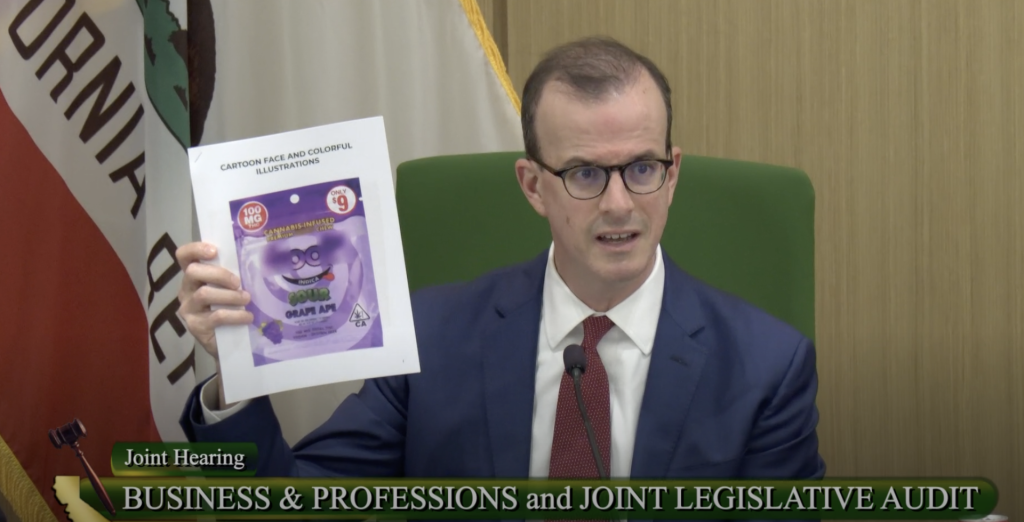
 A “joint” hearing of the CA Joint Legislative Audit and Asm. Business and Professions Committee was held in Sacramento on February 17 addressing cannabis packaging and its attractiveness to children.
Chair of the Joint Legislative Audit committee John Harabedian (D-Pasadena) opened the hearing and turned it over to Asm. Jacqui Irwin (D-Ventura) who requested an audit of cannabis packaging last year. The audit determined that laws and guidance are not always clear on what constitutes a package that is attractive to children, and that the DCC’s enforcement against companies with repeated violations was lacking.
DCC’s regulations prohibit cartoonish characters on cannabis packages, but examples were shown of gummy packages that arguably had such images, as well as those with images of marshmallows or candies and sweets like fruity rice, all of which had been determined to be within the agency’s guidelines. Also shown were bottles of drinks containing 100 mg of THC—ten times the standard adult dose—that provided no mechanism to consume a lower dose. It was recommended that CA either limit drink packages to 10 mg, unless a device is included to measure dosages.
Asm. Irwin pointed to increases in Poison Control Center calls and emergency room visits involving children ingesting cannabis, saying they are coming not just from the illicit market but also the legal, regulated one. It was pointed out that some of steepest increases in poison control center calls came after 2019 when hemp was descheduled at federal level and intoxicating hemp products proliferated. Also, it’s hard to distinguish if calls were coming from products on legal or illegal market. But Irwin kept coming back to, but some of the problems are from the legal market, to which DCC’s Christina Dempsey replied, certainly and said her department has taken steps to better coordinate and take action against violators.
Dempsey said the state audit happened during period where staff were still being combined from three different agencies that formerly regulated cannabis in CA. DCC has spent time developing a tool that will scan labels and highlight what staff might miss, she said, adding that in some cases it’s not obvious what’s attractive to youth. The agency is getting ready to roll that out their tool to licensees this summer.
DCC would love to have more inspectors, Dempsey said, but they have resource constraints. The agency has budget proposals under consideration for additional legal staff to review complaints, and to consolodate licensing systems, which are still in two separate databases (down from three, when Prop. 64 first took effect).
“We need cannabis products to look more like the pasta aisle than the cereal aisle,” Harabedian said, noting this his children don’t ask for pasta in the grocery store, but they want every cereal they see. He and others also objected to the name Root Beer being used on drink cans, to which the response was that root beer float was the name of a cannabis strain.
Several committee members like Legislative Audit Vice Chair Cabaldon asked if statutory clarity was needed on products like “Krispy Rice treats”? Asm. Hart asked, is the definition of child-attractive packaging or enforcement the issue? (Answers were unclear.) Asm. Bauer-Kahan noted that we must support the legal market, “it’s making us safer.” But we must protect children.
Asm. Berman, chair of Asm. Business and Professions committee, asked why strain names are a problem, saying that they’re used on flower, not products. He noted that this year marks 10 years of legal cannabis in CA, but the industry is still struggling to meet its expectations. He held up a package that “looks like it’s straight out of Alice in Wonderland,” calling it unacceptable.
Dr. Lynn Silver, a pediatrician and CDPH task force on packaging co-chair, noted that almost none of recommendations from the task force’s 2024 have been implemented. Those recommendations included moving to plain packaging or a system like Oregon’s where packaging is pre-approved. California has been a national leader in reigning in flavored tobacco, Silver noted, and should take the lead here as well. She raised an objection to Snoop Dogg onion rings and said that $70 million went from youth programs funded by cannabis taxes to the DCC to address child-attractive packaging.
Caren Woodson of CCIA noted that Prop. 64 tax money was to go to education and prevention. “How about instructing parents about safe storage?” she asked, noting that children can’t get into licensed cannabis retailers to see packages and must be accessing them at home.
Amy Jenkins of CaCOA said her organization just put out a White Paper based on an audit of 161 popular products, which found that 62% were compliant, 10% were clearly out of compliance, and the rest were unclear. CaCOA recommends:
1. Define observable design features
2. Align DCC guidance with regulation
3. Focus enforcement where risk is highest
“Protection without undermining the legal market is possible,” Jenkins concluded. The most egregious examples of dubious child-friendly products come from the illicit market, which has no age gating. The legislature has made substantial investments in enforcement, and needs to do more at the illicit retail level, she said.
Irwin said she would like to see CaCOA’s white paper, and was glad the industry was willing to work together for more precision in labeling.
During public comment, Dr. Alisa Padon from the Public Health Institute, said that with DCC funding, her organization used a Content Appealing to Youth Index and found measurable features like psychedelic effects that appeal to teens. Usage remains lowest in places without retail sales, she said, so the legal market matters.
Sam Rodriguez, who represents vertically integrated cannabis farmers from the Santa Barbara county area noted that labels that reflect the region – mountains, rivers, surfers – promote the industry and tourism for the county. While agreeing that cannabis must be kept away from youth, he asked, “Please be prudent and don’t overreach.”
Irwin’s last packaging bill was opposed by Cal NORML and the California cannabis industry and was vetoed by Gov. Newsom as overly broad. It disallowed any kind of picture, such as a picture of a farmer, on packages. The Assemblywoman has introduced a bare-bones packaging bill that will soon be flushed out, it is expected, along with a bill addressing marketing practices.